What happens if you add 40% more sugar than the recipe calls for?
What happens if you add 40% less sugar than the recipe calls for?
What happens if you add 40% more sugar than the recipe calls for and then reduce the amount of flour by the weight of sugar that you just added?
What happens if you add 40% less sugar than the recipe calls for and then increase the amount of flour by the weight of sugar that you subtracted?
These were some of the first questions that I asked during this chocolate chip cookie experiment. To answer these questions, I mixed up four batches that correspond to the questions, which I will call batch 1, batch 2, batch 3, and batch 4.
These batches are actually half batches with respect to the original Nestle Tollhouse recipe.
The original recipe calls for
- 2 and 1/4 cup flour (which I measured out to be 355g)
- 1 teaspoon baking soda
- 1 teaspoon salt
- 1 cup butter, softened (2 sticks, or 224g)
- 3/4 cup granulated sugar (which I measured out to be 165g)
- 3/4 cup packed brown sugar (which I measured out to be 144g)
- 1 teaspoon vanilla extract
- 2 large eggs
- 12oz chocolate chips (340g)
- 1 cup chopped walnuts (which I measured to be 140g)
Batch 1 Recipe (half batch) – Plus 40% Sugar
- 177.5g all purpose flour
- 1/2 teaspoon baking soda
- 1/2 teaspoon salt
- 112g butter, softened
- 115.5g sugar (165/2=82.5; 82.5*40%=33; 82.5+33=115.5g)
- 100.8g dark brown sugar (144/2=72; 72*40%=28.8; 72+28.8=100.8g)
- 1/2 teaspoon vanilla extract
- 1 large egg
- 170g chocolate chips
- 70g chopped walnuts
Batch 2 Recipe (if not noted, it is the same as batch 1 recipe)- Minus 40% Sugar
- 49.5g sugar
- 43.2g dark brown sugar
Batch 3 Recipe – Plus 40% Sugar, Minus Flour
- 115.7g all purpose flour (355/2=177.5; 177.5-33-28.8=115.7g)
- 115.5g sugar
- 100.8g dark brown sugar
Batch 4 Recipe – Minus 40% Sugar, Plus Flour
- 239.3g all purpose flour
- 49.5g sugar
- 43.2g dark brown sugar
Results – Batch 1 spread more than the original recipe. Batch 2 spread less. Batch 3 spread a lot more. Batch 4 barely spread at all. In terms of taste and texture, the ones with more sugar were chewier and denser. The ones with less were doughier. Mixing up and baking batches 3 and 4 is a great way to see the relationship between sugar and flour in a cookie, as one contains almost double the amount of sugar to flour and the other contains over double the amount of flour to sugar.
Below you can see a picture where, from left to right, are cookies from batches 4, 1, 2, 3 (so, most sugar-to-flour ratio to least.
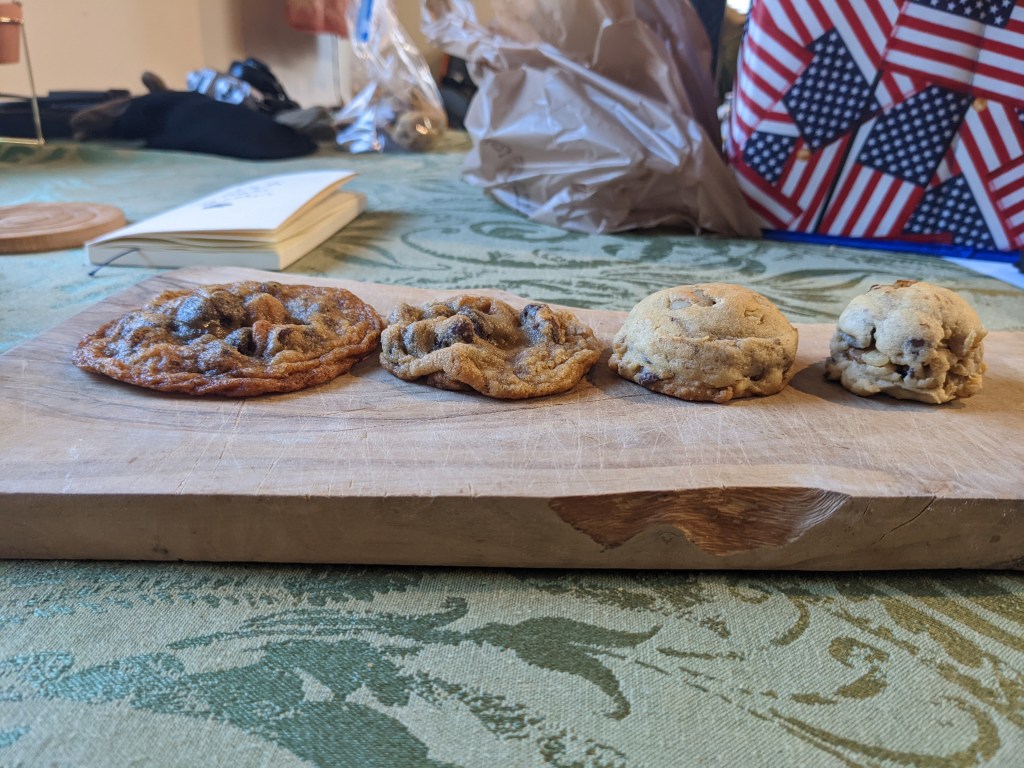
They were all baked in the same oven, at the same temperature, for the same amount of time.
They were all delicious.
 David Weddle Cookies