I have been reading up on baking soda. Baking soda is Sodium Bicarbonate, which is NaHCO₃. It’s been a while since my days taking General Chemistry at Community College, so I don’t know all the appropriate jargon, but I am brushing up some for the purpose of understanding what goes on when I bake cookies.
Baking soda is a base, and the purpose of it in a recipe is to react with an acid, which then produces a gas (like carbon dioxide) that dissipates upward and out of the cookie. As it pushes upward, it helps leaven the cookie. This is not the only way cookies are leavened, but it is one way – and it is a very interesting way. You can see this reaction happen when you make pancakes. When the pancakes are on the griddle, you will start to see little bubbles forming on top of the pancake. This, at least in part, is the gas – produced from the baking soda reacting with an acid – leaving the pancake.
In the original Toll House chocolate chip cookie recipe, the acid that reacts with the baking soda is found in brown sugar. Brown sugar is essentially granulated sugar mixed with molasses. Molasses is an acidic biproduct of manufacturing cane sugar.
I am curious how much brown sugar is needed if I am only concerned with providing enough acid to react with the base to produce enough gas to leaven the cookie. If you know how much of everything you are putting into the cookie, you can calculate how much of the acid and how much of the base you need. For instance, if I knew how much acid was in brown sugar, then I could do a little math and figure out how much brown sugar would be needed for however much baking soda is present. The problem is that I have no idea how much acid is in brown sugar. I can’t find it anywhere. So, I will put this train of thought on the proverbial back-burner for now.
I think it’s important to note that not all recipes call for baking soda. Some recipes instead call for baking powder and some call for both soda and powder. Baking powder is a mixture of baking soda and a powdered acid to react with the baking soda. Whether a recipe calls for baking soda, baking powder, or a mix of both depends on the presence and quantity of acidic ingredients otherwise present in the recipe. From reading about baking powder, I learned of a common kitchen ingredient called cream of tartar.
Cream of tartar is Potassium Bitartrate, which is KC4H5O6. Just as baking soda is a readily available base, cream of tartar is a readily available acid. I happen to have cream of tartar in my pantry, but I never really used it or knew much about it. It’s a powdered substance that looks similar to baking soda. My thoughts are that I can use both of these to create my own baking powder to cause a chemical reaction to leaven cookies. Why would I want to do this? Well, to gain a better understanding of what is happening in my cookie. I’ll start with figuring out how much cream of tartar I’ll need to react with baking soda.
The original Toll House recipe calls for 1 teaspoon of baking soda. This is about 5g. One teaspoon of cream of tartar is 4g. In order to know how much of each I would need, I need to know what chemical reaction is occurring. Like I said, it has been a while since my General Chemistry days, so I will use Google to figure out what this reaction is. Here it is:
2NaHCO3 + 2KC4H5O6 → Na2C4H4O6 + K2C4H4O6 + 2H2O + 2CO2
This means that two sodium bicarbonate and two potassium tartrates react to produce…all of that. I don’t know what the first two are, but the last two are water and carbon dioxide. For my purposes, all I need to know is that an equal amount of baking soda and cream of tartar are needed. It may seem like I could just use what the original recipe calls for of baking soda (1 teaspoon, or 5 grams) and add an equal amount by weight of cream of tartar (just over 1 teaspoon) to get the same 5 grams. But this would be wrong.
In order to add the same amount of sodium bicarbonate and potassium tartrate, I need to know their molar masses. Google is my friend here. For sodium bicarbonate, it is 84g/mol. This means that one mole of sodium bicarbonate (and a mole is just a large amount of something), weighs 84g. Knowing this, I can determine that there are 0.05952 moles of sodium bicarbonate in 5g baking soda. I would need an equal amount of potassium tartrate. The molar mass of potassium tartrate is 188g/mol. 0.05952 moles of this would weigh about 11g. So, I need 5g of baking soda, which is 1 teaspoon, and 11g of cream of tartar, which is 2 and ¾ teaspoons.
Okay! Now that I know this, I can prepare for an experiment. I will have four batches:
- The original recipe, except it will be all granulated sugar (so no brown sugar). The purpose of this batch is to take away the acid (brown sugar) while leaving the base (baking soda). In doing so, I am expecting no leavening.
- The original recipe including the appropriate amount of granulated and brown sugars. The purpose of this batch is to observe the effect brown sugar reacting with baking soda has on the cookie.
- The original recipe including the appropriate amount of granulated and brown sugars, minus the baking soda. This batch is similar to the first batch, except instead of taking away the acid, I am taking away the base. In doing so, I am expecting no leavening.
- The original recipe, except it will be all granulated sugar (so no brown sugar) and it will include the addition of 2 and 3/4 teaspoons of cream of tartar. This batch will replace the brown sugar with a different acid to react with the baking soda.
In this experiment, I will alter the original recipe slightly. Instead of using softened butter, I will be using melted butter. This will hopefully get rid of the mechanical leavening that takes place when you cream the sugar with the butter. The purpose of this is to try and maintain baking soda as the main leavening factor.
I will conduct this experiment (hopefully) within the next week and share my results here!
Thoughts After Experiment – Round 1
May 9, 2022
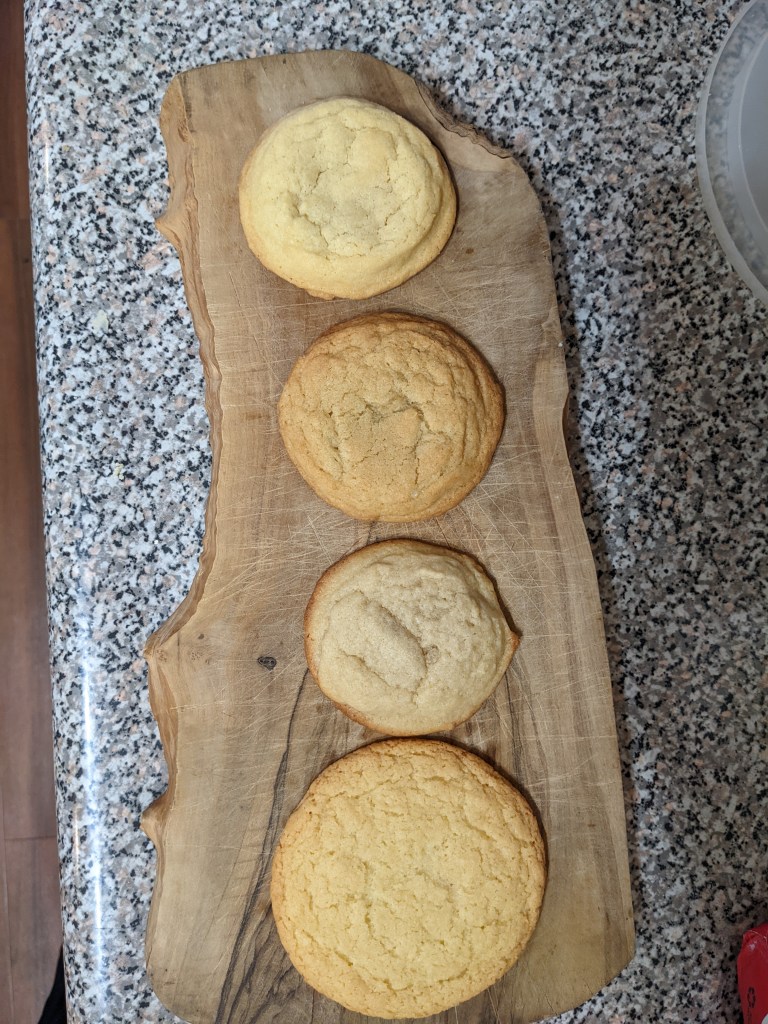
My four batches produced results different from what I had expected. I will need to do another round of this experiment to try and reproduce these results. I will plan to do so within the next week.
The first two batches were very similar in taste and texture, and they differed in appearance only with respect to their color – the second batch being darker in color. They were crispy, chewy, and delicious – reminiscent of a sugar cookie. I had expected the first batch to be less leavened than the second. The second contained the acid and base needed to produce carbon dioxide; the first batch only contained the base. However, they appeared equally leavened.
The third batch was like the second minus the baking soda. These cookies were more pale than the first batch, despite the brown sugar present. This makes me think that baking soda does more than just leaven a cookie – it may also help with browning. This may have to do with baking soda reducing the overall pH of the cookie. It is difficult to describe the texture of the third batch cookies. The edges were crispy and the middle was chewy, but not in the way you’d expect from a chocolate chip cookie. It was weird. That’s all I can say of it right now.
The fourth batch surprised me the most. This batch took away the brown sugar and added cream of tartar. I was expecting a cookie similar to the first batch, except with more rise to it. Instead, I received a cookie that spread out – a lot. The result was a tan cookie, crispy around the outside and chewy in the middle in a very pleasant way. The fact that it spread so much makes me skeptical of the results. I think I may have done something wrong.
Thinking back to the fourth batch, I recall the butter being a little warmer than with the other batches. I melted the butter by putting a bowl over a pot of simmering water until the butter melted. I then began to build the dough. When I repeat the experiment, I will want to try and keep this variable as constant as possible. I want to use melted butter, as explained above, but I don’t want the butter to be too warm. My strategy will be to melt the butter and then let it cool for at least 10 minutes before building the dough.
The rest of the ingredients are easily held in constant. The flour and sugar are weighed before I start to build the dough. I use the same measuring spoons to measure the salt, baking soda, and vanilla extract for each batch. I also weigh the eggs to keep that a constant. The temperature of the oven is as constant as I can keep it. They are all baked for the same amount of time. The temperature of the butter is the only variable that I didn’t really account for and will have to pay more attention to when I try and recreate the results.
Thoughts After Experiment – Round 2
May 11, 2022
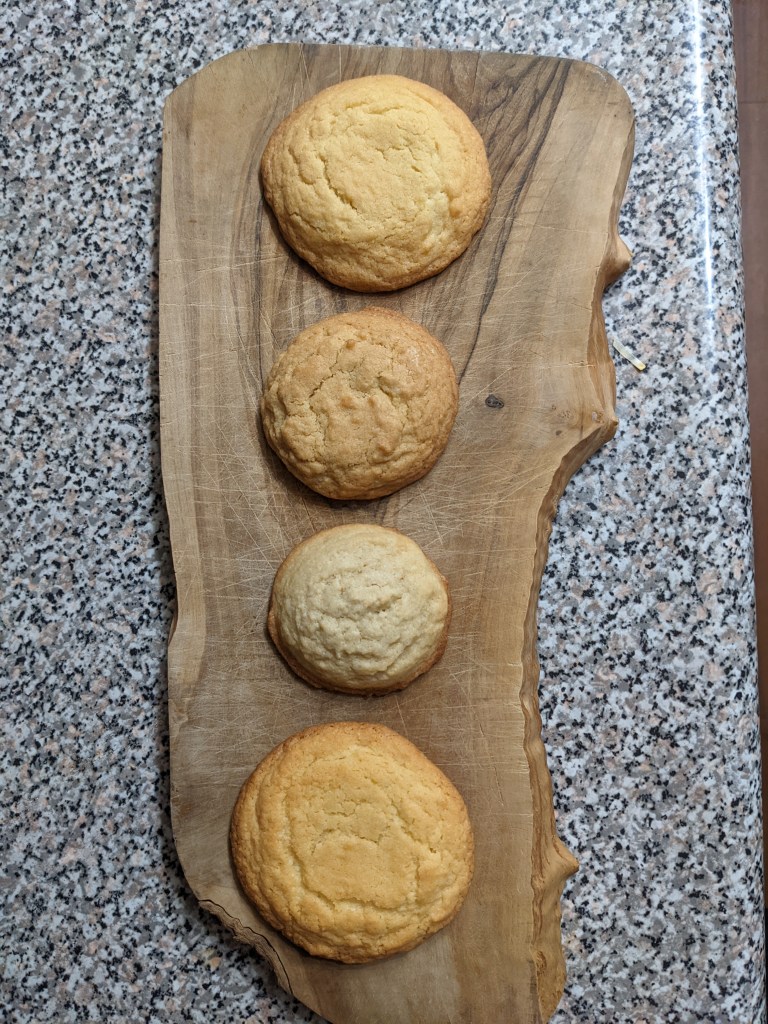
Here are the cookies after I redid the experiment. I kept all the ingredients the same, but I did make some changes:
First, I tried to ensure the butter was the same temperature for all batches before I built the dough. I melted the butter and waited for it to get down to 80 degrees Fahrenheit before moving forward. I chose that temperature because it seemed pretty close to “room temperature” and because I didn’t want to wait any longer. Doing this did make a difference, I think. For the first round, batch 4 spread out a lot. I think this was a result of the butter (and thus, the dough) being very warm as I built the dough and portioned them onto the baking sheet. This is interesting because it may suggest that a warmer dough (which can be achieved by starting with warm butter) will result in a cookie that spreads more. I’ll revisit this idea at some point.
Second, I increased the time I baked these for from 11 minutes to 12 minutes. I felt as though I didn’t let them bake for as long as I should in the first batch. Increasing the time for just 1 minute made a difference. First, the cookies browned more. This, I think, is good. Cookies are supposed to brown. Brown means flavor and aroma. Letting the cookies bake for a longer amount of time also allowed the cookies to spread more. This showed the difference between the first two batches. The first batch spread more than the second and I think this is a result of the second rising more – which was my original prediction. The last cookie spread about as much as the first, and was almost indistinguishable from the first, which makes me think that I either did not put enough cream of tartar in or…something else. I’m not sure. I will have to test cream of tartar more – perhaps by doing a few batches where I have the amount of cream of tartar added be the only variable.
Everything else remained the same. The results were similar to the first, but different in some expected ways, as described above. I don’t think I will reproduce this exact experiment again, at least not next. I think I will next add back in the chocolate chips and the walnuts and redo these four batches. After that, I will do some other experiments around baking soda, baking powder, and cream of tartar. Mainly, I will have batches where I keep everything the same, but increase one of those as a variable in different batches. I will also want to add in creaming butter and sugar into this experiment to see what difference that makes. So, my next few experiments around baking soda will be:
- Re-do the original experiment, but add in chocolate chips and walnuts.
- Do an experiment where I have four batches of increasing baking soda.
- Do an experiment where I have four batches of increasing baking powder.
- Do an experiment where I have four batches of increasing cream of tartar.
Since I am doing quarter batches and can easily do one of these experiments in one evening – but also taking into consideration that I will be baking some other things in the next couple of weeks, and also that I may want to repeat experiments before moving on – I will give myself one month to complete these. I will update this as I do so.
Adding Chocolate Chips and Walnuts – Round 1
May 22, 2022
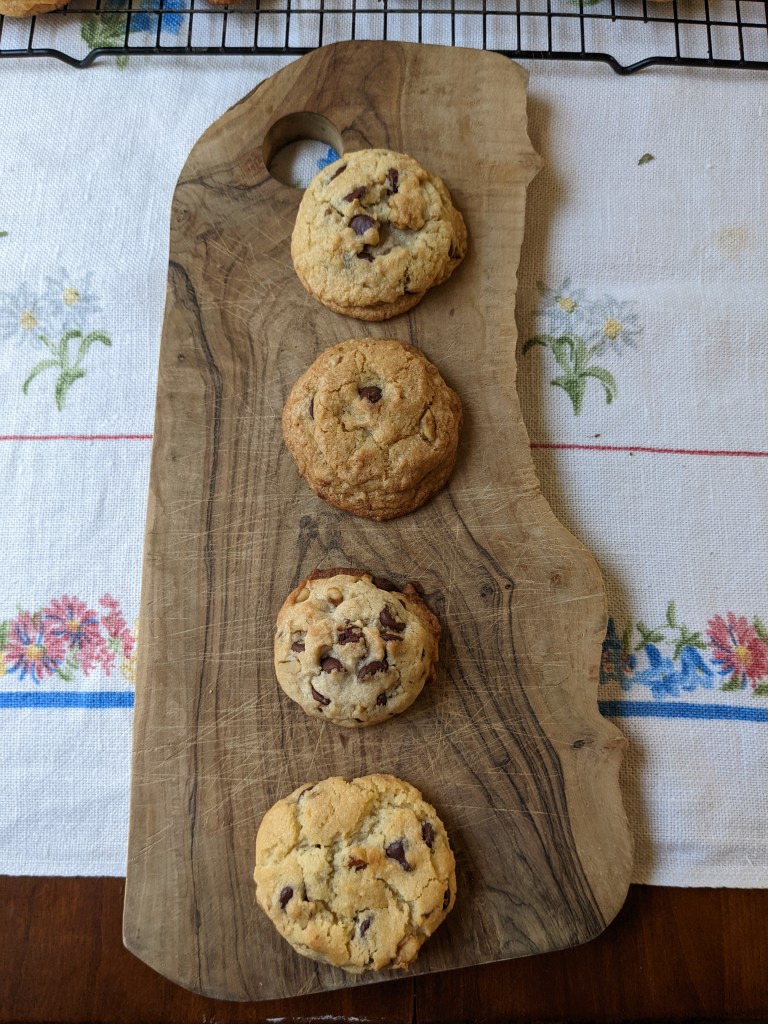
I redid the experiment and added chocolate chips and walnuts back in. From top to bottom we have batches 1 through 4. They acted much like the original experiment. Specifically, batches 1 and 4 were similar. Batch 2 was like batches 1 and 4 but darker. And batch 3 had a dark outside, but was pale in the middle. This is all expected. I will likely do one more round of these batches before moving onto the next part of this experiment. Note: I did the same thing I did in my last batch to maintain consistency: I melted the butter and let it cool to 80 degrees before building the dough and I baked them all for 12 minutes in 375 degrees Fahrenheit.
 David Weddle Cookies